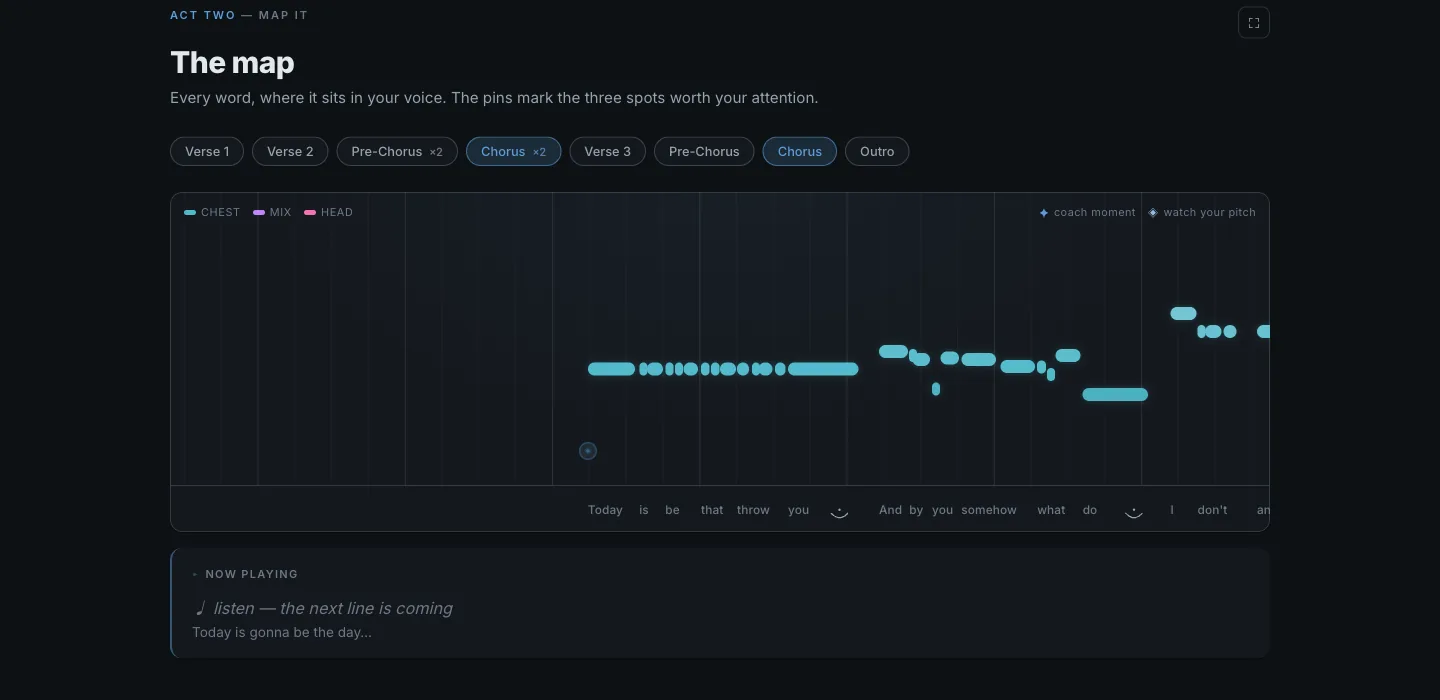
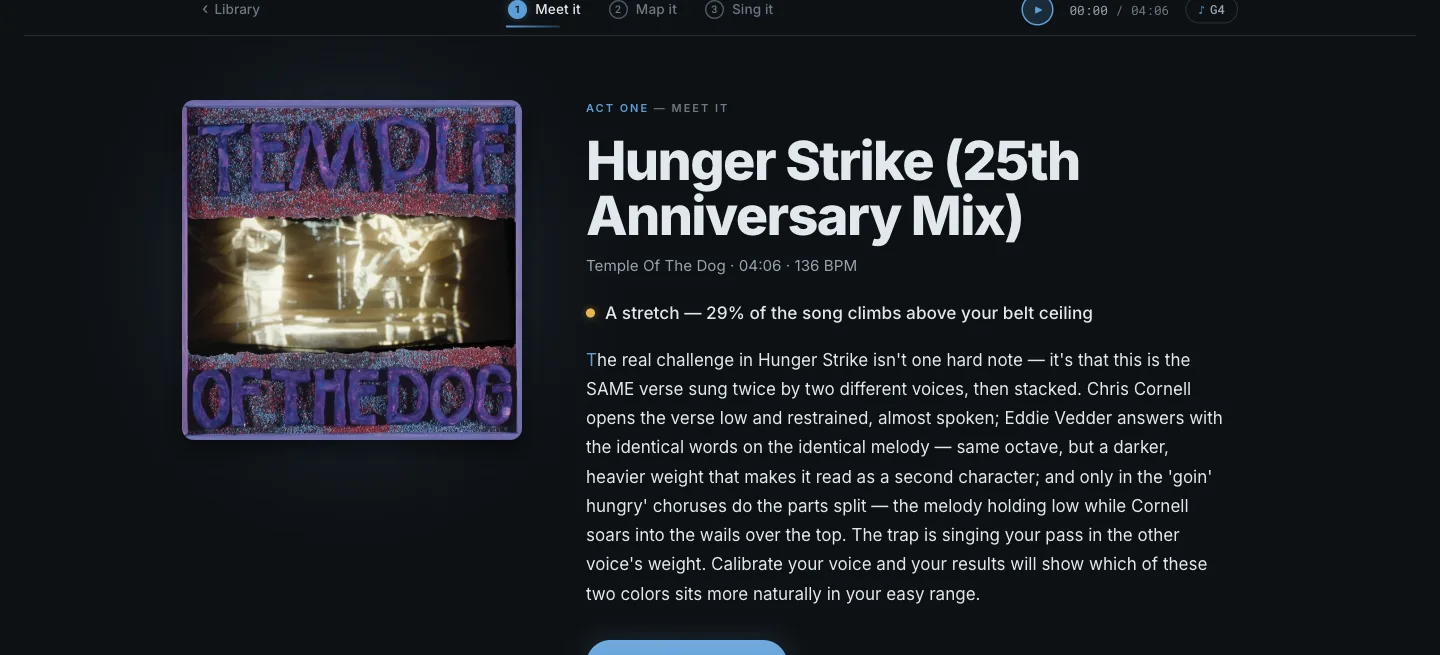
Vocal Booth draws every song note by note from the real recording — then measures it against your range, so you know where it sits comfortably, where it stretches you, and what to do about it.
A songbook gives you someone's transcription. Vocal Booth listens to the recording itself.
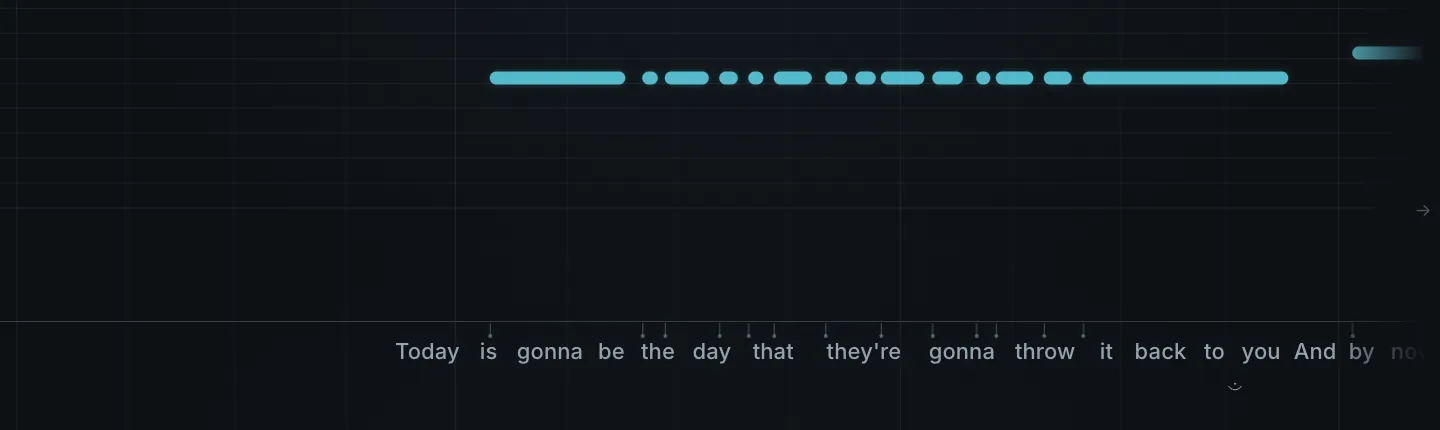
The map shows each note's register — chest, mix, or head voice — which words carry the tune and which just color it, and where to breathe, with a countdown so the breath actually happens.
Slide your voice low, then high — two guided glides, about 45 seconds. That's calibration. From then on, every song reports how it sits in your voice, not some average singer's.
A stretch is a measurement here, not a verdict on you.
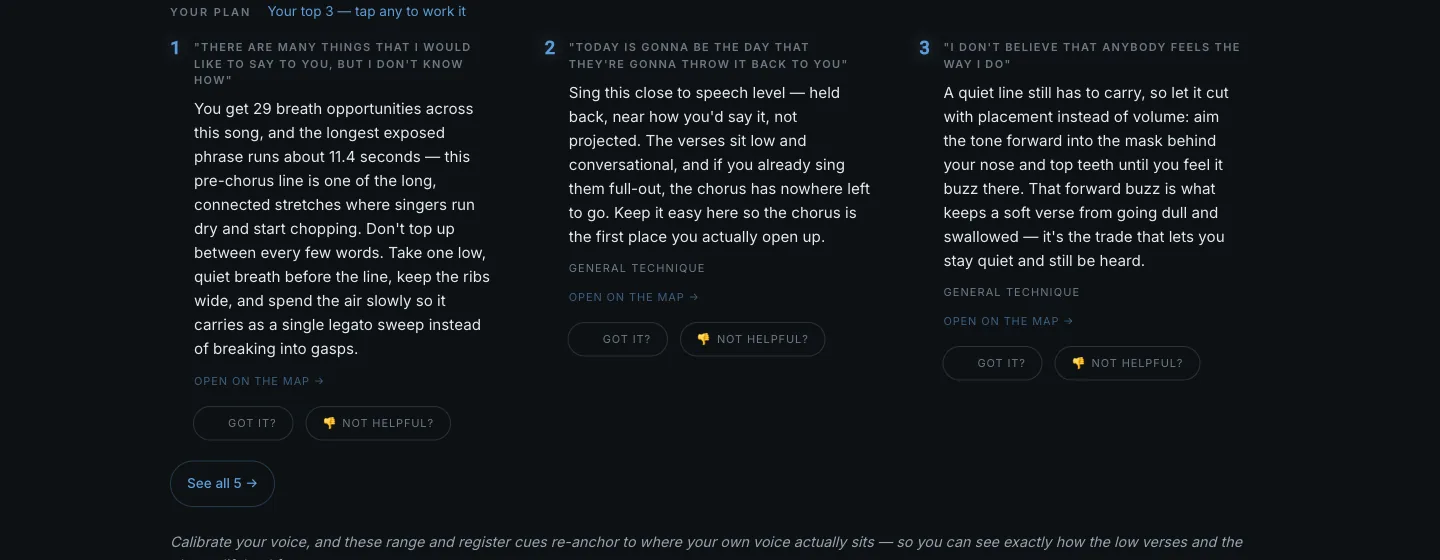
Pull up a song and read the brief Abigail wrote for it — what this song actually asks of a voice, and the few moments worth your attention.
Abigail's coaching isn't generic — every line is drawn from the song's own measured audio and the research behind the technique, then checked against both before it reaches you.
So when she says a phrase runs 11.4 seconds and singers tend to chop it, that came from the recording — and the advice opens right on that spot in the map.
Everything you need to work a song lives in one tab, next to the map.
Belt, twang, head voice, breath support — sixteen techniques, each taught as what it should feel like, with the mistake described so you can catch it yourself. The musical terms stay, in plain words, so a voice lesson or a choir rehearsal will make sense too.
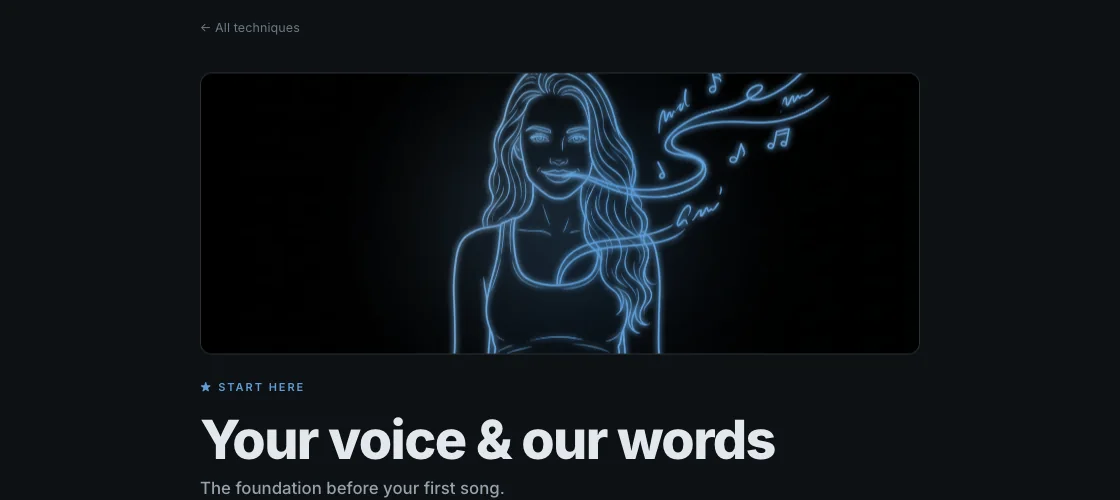
New to singing entirely? The "Start here" primer, narrated by Abigail, assumes nothing: what your voice physically does, the handful of words the app uses with you, and a one-minute experiment for each idea.


On a duet, Vocal Booth knows whose line is whose. Pick your part and the map, the reference vocal, and the coaching all follow the voice you're actually singing.
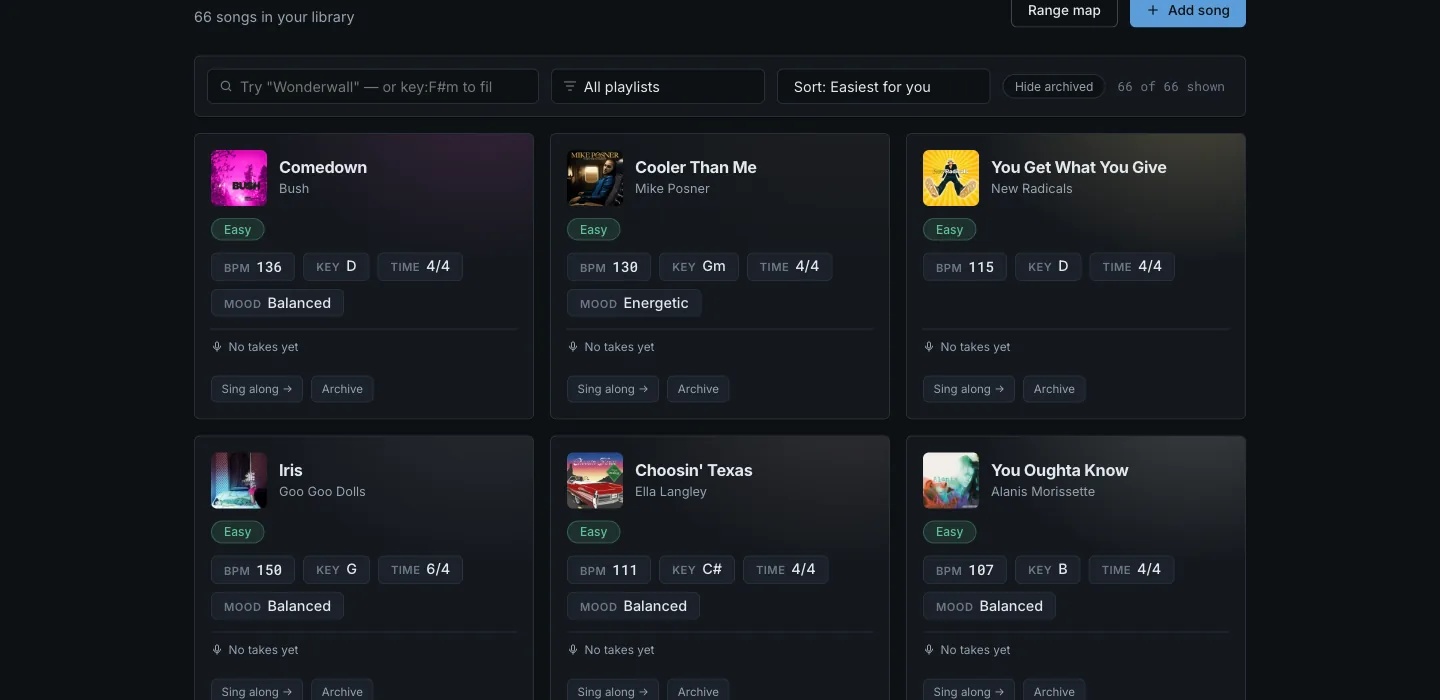
Your library isn't a preset workbook. Search and add the songs you actually want to sing, or upload your own file — Vocal Booth listens to the recording and measures what matters: tempo, key, range, difficulty, mood. Then it sorts them by what's easiest for you.
Songs are metered, not endless: your account starts with 3, and each one after that is $3. Analysing a track is real work, and we'd rather charge for it than pad the page with ads.
Five browser drills — intervals, chords, in-tune detection, pitch matching, and A/B comparison — sharpen the ear the map trains.
Guided warm-ups before you sing, and a weekly plan that keeps the fundamentals moving between songs.
Add it to your home screen like an app. The map, the practice room, and your library, wherever you sing.
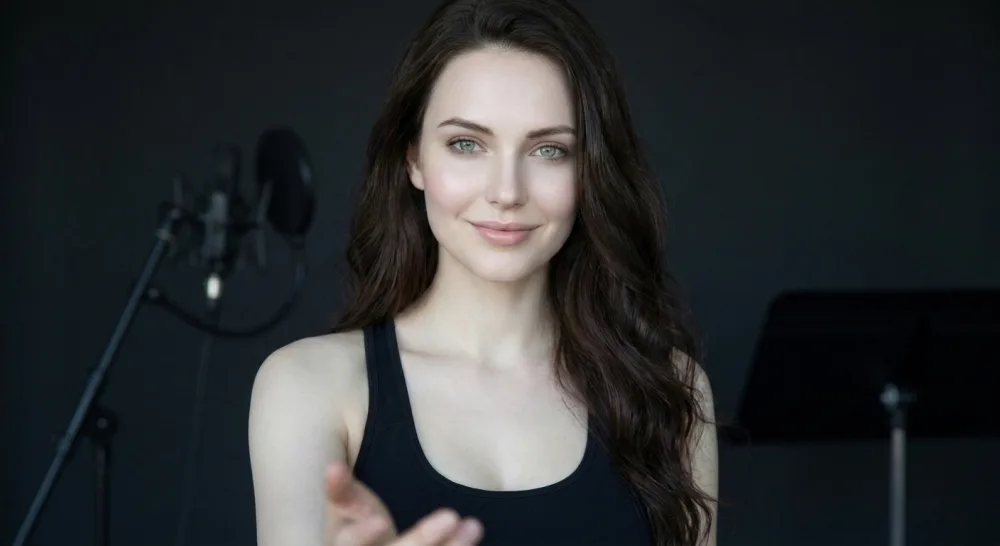
The coaching has a face — and a way of working. She's the expert ear who walks you through every session.
She studies the song you're about to sing, and shows you the one thing to work on next.
Most singers don't quit because they lack talent. They quit because no one ever told them, plainly, what to do next — just "sing it again," or worse, "that was great!" when it wasn't. Abigail exists to end that.
She won't pretend the passaggio isn't awkward or that breath support clicks overnight — the long plateau before the hard parts cooperate is real, and she'll just show you the way through, one repeatable sensation at a time, and she never makes it up.
The coaching is a craft, and we're scaling it deliberately — singer by singer, often by way of a voice teacher. Ask for an invite below; if a seat opens for you, it lands in your inbox, and one tap signs you in.